Fox & Clubs - Dark on Light Only
Use on cream, pearl, white, pale paper, and other light surfaces.
Solid dark-green artwork with transparent eye, ear, cheek, and cutout details.
Download the corrected logo files, choose the right artwork for each surface, and review the production checks needed before proofs, signage, apparel, print, digital, or embroidery leave your desk.

These are separate surface-role artworks. Do not invert, recolor, filter, mask, blend, trace, or place either mark inside an improvised shape.
The fox-and-clubs pair is the approved standalone mark system. The light-surface and dark-surface files are different constructions, not color alternatives.
Use on cream, pearl, white, pale paper, and other light surfaces.
Solid dark-green artwork with transparent eye, ear, cheek, and cutout details.
Use on navy, forest green, dark photography, and other dark surfaces.
Purpose-built white outline artwork; do not derive it from the dark-green mark.
Most apparel work should use the fox-and-clubs mark without the wordmark. Embroidery is not a generic logo download: the file, thread, backing, placement, and finished size all need to agree before production.
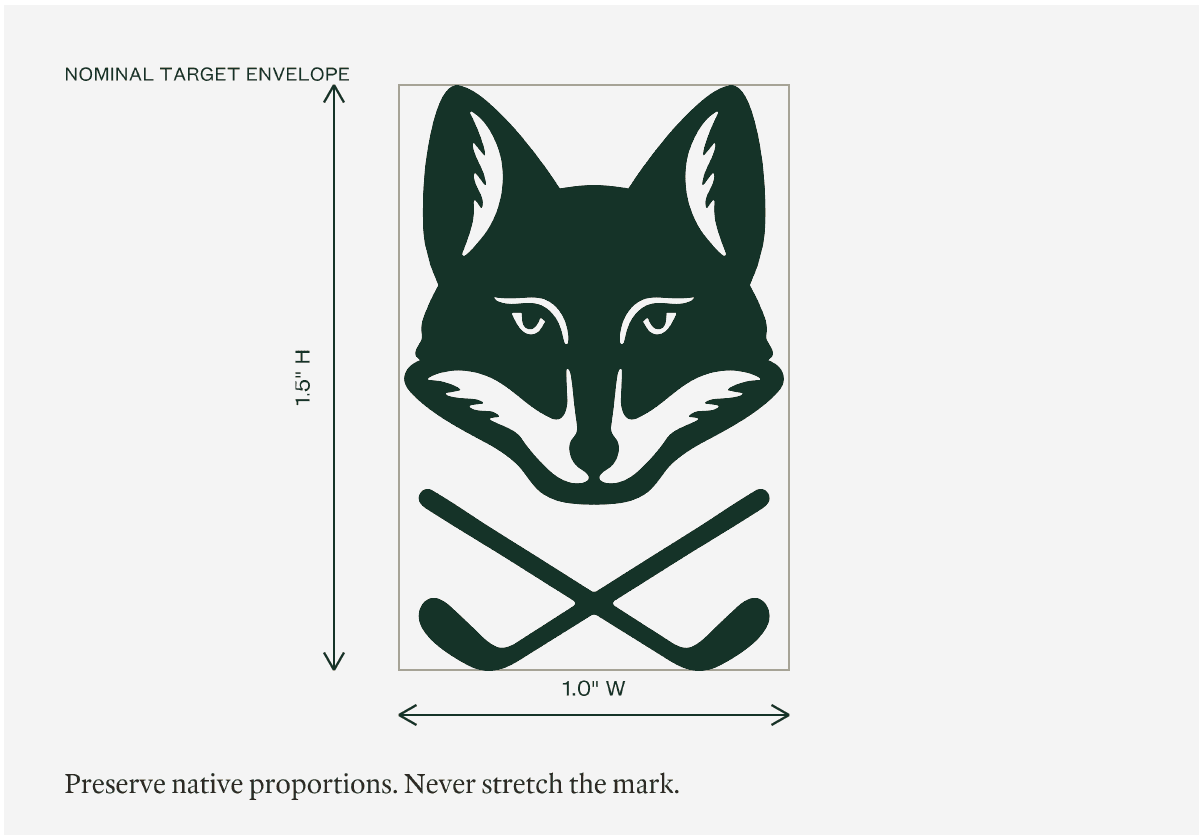
Fit the native-proportion mark inside the nominal 1.5-inch-high by 1.0-inch-wide envelope. Do not stretch the mark to force both dimensions.
Light garments
Use solid dark-green artwork. Preserve the transparent facial detail and native proportions.
Dark garments
Use outlined light artwork. Reject filled-white faces, washed-out detail, and improvised background shapes.
Artwork
Fox-and-clubs mark only
Do not use a wordmark or rebuild the mark from a PNG, screenshot, or PDF.
Target envelope
1.5 in H x 1.0 in W
Fit native-proportion artwork inside this envelope; do not force both dimensions.
Digitized file
Job-specific DST
DST depends on size, fabric, stabilizer, thread, placement, and machine setup.
Approval
Physical sew-out required
A digital mockup is not enough for final approval on apparel or soft goods.
Hold until the physical sew-out is approved for the exact garment, placement, thread, and size. A reused DST from another garment or size should be treated as a new proof.
The guide treats lockups, wordmarks, face marks, and the fox-and-clubs mark as different tools. The circular badge is an approved self-contained merchandise mark. Do not rebuild one family from another.
Use a lockup when the mark and club name must travel together. The primary lockup is preferred; use the secondary lockup when the logo will be very small and the fox face must stay more visible.
Use the stacked wordmark when there is adequate space. Use the single-line wordmark only when space is limited.
Approved for merchandise, including embroidered headwear. Use only the supplied self-contained badge artwork and preserve its rings, proportions, and colors.
Use the fox face only when the wordmark or full name is visible nearby. Use the fox-and-clubs mark when a standalone mark is needed.

Fox Face - Forest Green
The brand guide is for decisions and proof approval. Artwork must come from supplied production assets, never from screenshots or copied PDF elements.
Identity elements can scale up or down, but vendor proofs should preserve clear space, native proportions, and the recommended lower limits.
Maintain minimum clear space around identity elements equal to at least half the width of the logo. More space is preferred when the artwork is near trim, stitching, hardware, seams, busy imagery, or other brand marks.
Logo Lockup
Minimum height 1.2 in
Fox Face
Minimum height 0.65 in
Fox & Clubs Mark
Target envelope 1.5 in H x 1.0 in W
Stacked Wordmark
Minimum height 0.25 in
Single-Line Wordmark
Minimum height 0.05 in
Most incorrect proofs come from treating surface-role artwork as a color swap. Use the supplied role-specific file and leave it unchanged.
Red-X examples should be rejected before proof approval. They are shown only to make the production mistake clear.
Do not use the outlined light artwork on cream, pearl, white, or other light surfaces.

Do not invert or rebuild the solid mark to create a filled-white face on dark fabric. Use LIGHT_ON_DARK_ONLY instead.
Do not put a transparent mark inside an invented circle, square, patch, panel, or badge.
Do not stretch, squeeze, redraw, trace, or force the logo to match a fixed box.
The vendor defaults are the current website and design-system colors. The four core colors carry most production work; supporting neutrals and editorial accents appear in some Mackenzie materials and should only be used when the approved proof calls for them.
Use these values as the current vendor reference. For print, embroidery thread, signage, leather, metal, paint, and fabric, match against a physical swatch or vendor proof before production.
#18342a
RGB 24, 52, 42
PMS 3435 U / 3308 C
Primary brand color
#2f5a48
RGB 47, 90, 72
PMS 7727 U / 625 C
Secondary green
#0c1d2a
RGB 12, 29, 42
PMS 289 U / 2380 C
Dark backgrounds
#dfbd42
RGB 223, 189, 66
PMS 102 U / 107 C
Accent only
#f5f2ed
RGB 245, 242, 237
PMS verify by process
Warm light surface
#faf8f5
RGB 250, 248, 245
PMS verify by process
Lightest paper surface
#4d4939
RGB 77, 73, 57
PMS verify by process
Warm text and detail
#aca599
RGB 172, 165, 153
PMS verify by process
Secondary text and rules
#c7b3ac
RGB 199, 179, 172
PMS verify by process
Soft supporting surface
#461a1b
RGB 70, 26, 27
PMS verify by process
Restricted editorial accent
#6f2d14
RGB 111, 45, 20
PMS verify by process
Restricted editorial accent
Primary display typeface for headlines, lockups, and elegant typographic moments. Vendors should use their own licensed copy unless Mackenzie confirms redistribution rights for a specific job.
Secondary typeface for body copy, UI elements, production notes, and supporting text. Vendors should use their own licensed copy unless Mackenzie confirms redistribution rights for a specific job. Do not recreate the wordmark in a font.
01
Place the current approved production asset supplied with the job.
02
Select the file by surface role, not by color preference.
03
Place the artwork unchanged: never convert, derive, invert, recolor, trace, or filter.
04
Preserve proportions, clear space, and minimum size.
05
Reject hollow, washed-out, or improvised-background versions.
06
For embroidery, require job-specific DST, written thread colors, and an approved physical sew-out.
Email [email protected] with the intended use, surface, size, production method, and proof deadline. Brand guide PDFs, EPS, and embroidery DST files are supplied only when they match the job. Vendors should use their own licensed font copies unless Mackenzie confirms redistribution rights for the specific job.